
District → Patna
State → Bihar
Barh is a town and Subdivision in the Patna district of the Bihar. In India, a Subdivision is a subdivision of a district responsible for the administration and revenue collection of a specific area within the district. Subdivisions play a crucial role in the local governance structure, contributing significantly to the development and administration of their communities.
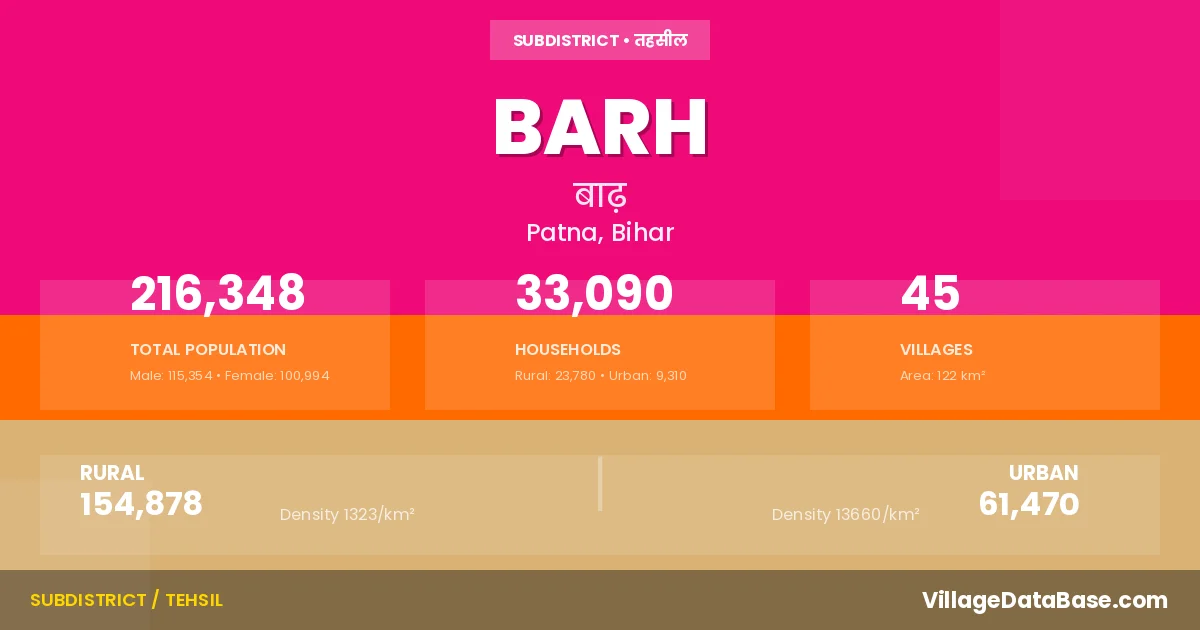
According to the 2011 census The total area of Barh Subdivision is 122 km², with a population of 216348 people. The population density is 1,780 inhabitants per square kilometre, and there are approximately 33090 houses in the sub district.
Barh Subdivision comprises about 45 villages. Below is a list of these villages along with information about their respective gram panchayats and the nearest town:
| # | Village Name | Gram Panchayat | Nearest Town |
|---|---|---|---|
| 1 | Achuara | Rahimpur Rupas | Barh (3 km) |
| 2 | Agwanpur | Agwanpur | Barh (5 km) |
| 3 | Akbarpur | Ibrahimpur | Barh (3 km) |
| 4 | Alampur | Bhatgawn | Barh (5 km) |
| 5 | Atnauwan | Sarkatti Saidpur | Barh (10 km) |
| 6 | Bahrawan | Agwanpur | Barh (8 km) |
| 7 | Banarsi | Naruada | Barh (5 km) |
| 8 | Bariarpur | Dhanwan Mobarakpur | Barh (6 km) |
| 9 | Bazidpur | Bhatgawn | Barh (5 km) |
| 10 | Bazitpur | Dhanwan Mobarakpur | Barh (5 km) |
| 11 | Bhatgawanan | Bhatgawn | Barh (5 km) |
| 12 | Birhana | Berhana East | Barh (5 km) |
| 13 | Burhanpur | Dhanwan Mobarakpur | Barh (5 km) |
| 14 | Dahaur | Ibrahimpur | Barh (3 km) |
| 15 | Danisman Chak | Bhatgawn | Barh (5 km) |
| 16 | Dhanwan | Dhanwan Mobarakpur | Barh (7 km) |
| 17 | Diara Malahi | Ibrahimpur | Barh (3 km) |
| 18 | Dumaria | Nadawan | Barh (6 km) |
| 19 | Ekdanga | Ekdanga | Barh (3 km) |
| 20 | Goar | Nadawan | Barh (5 km) |
| 21 | Hajipur | Rangbigha | Barh (7 km) |
| 22 | Hajipur English | Rangbigha | Barh |
| 23 | Hasan Chak | Agwanpur | Barh (8 km) |
| 24 | Hasanpur | Agwanpur | Barh |
| 25 | Ibrahimpur | Ibrahimpur | Barh (5 km) |
| 26 | Itawa | Dhanwan Mobarakpur | Barh (7 km) |
| 27 | Jalgobind | Ibrahimpur | Barh (5 km) |
| 28 | Langarpur | Bhatgawn | Barh (5 km) |
| 29 | Majra Bolaur | Rangbigha | Barh (8 km) |
| 30 | Masatthu | Ekdanga | Barh (10 km) |
| 31 | Mobarakpur | Dhanwan Mobarakpur | Barh (5 km) |
| 32 | Mogal Chak | Ekdanga | Barh (10 km) |
| 33 | Mokimpur | Agwanpur | Barh (7 km) |
| 34 | Nadwan | Nadawan | Barh (5 km) |
| 35 | Nawada | Naruada | Barh (5 km) |
| 36 | Pura Part In Athmalgola C D Block | Dhanwan Mobarakpur | Barh (7 km) |
| 37 | Rahimanpur | Rahimpur Rupas | Barh (5 km) |
| 38 | Rana Bigha | Rangbigha | Barh (5 km) |
| 39 | Sahri | Shohari | Barh (5 km) |
| 40 | Saidpur | Sarkatti Saidpur | Barh (15 km) |
| 41 | Salarpur | Dhanwan Mobarakpur | Barh (5 km) |
| 42 | Sarkoti | Sarkatti Saidpur | Barh (12 km) |
| 43 | Sikandra | Dhanwan Mobarakpur | Barh (5 km) |
| 44 | Soima | Berhana East | Barh (8 km) |
| 45 | Talibpur | Naruada | Barh (5 km) |
The population is distributed between urban and rural areas as follows:
| Particulars | Rural | Urban | Total |
|---|---|---|---|
| Total Population | 154878 | 61470 | 216348 |
| Male Population | 82531 | 32823 | 115354 |
| Female Population | 72347 | 28647 | 100994 | Population Density | 1323 / km² | 13660 / km² | 1,780 / km² |
The distribution of households in the Barh is:
| Rural Households | Urban Households | Total Households |
|---|---|---|
| 23780 | 9310 | 33090 |
Q: What is Barh?
A: Barh is a town and in the Patna district of the Bihar.
Q: What is the total area of Barh Subdivision?
A: The total area of Barh Subdivision is 122 km².
Q: What is the population of Barh Subdivision according to the 2011 census?
A: According to the 2011 census, the population of Barh Subdivision is 216348.
Q: What is the population density of Barh Subdivision?
A: The population density of Barh Subdivision is 1,780 inhabitants per square kilometre.
Q: How many houses are there in Barh Subdivision?
A: There are approximately 33090 houses in Barh Subdivision.
Q: How many villages are there in Barh Subdivision?
A: There are about 45 villages in Barh Subdivision.
Q: Which is the largest village by population in Barh Subdivision?
A: The largest village by population in Barh Subdivision is Birhana, with 18504 people.
Q: Which is the smallest village by population in Barh Subdivision?
A: The smallest village by population in Barh Subdivision is Hajipur English, with 0 people.
Q: Which is the largest village by area in Barh Subdivision?
A: The largest village by area in Barh Subdivision is Birhana, with 1135 km².
Q: Which is the smallest village by area in Barh Subdivision?
A: The smallest village by area in Barh Subdivision is Langarpur, with 29 km².
Q: What is the male population of Barh Subdivision?
A: The male population of Barh Subdivision is 115354.
Q: What is the female population of Barh Subdivision?
A: The female population of Barh Subdivision is 100994.
Q: How many villages in Barh Subdivision have a population of less than 100?
A: There are 2 villages in Barh Subdivision with a population of less than 100.
Q: How many villages in Barh Subdivision have a population between 500 and 999?
A: There are 4 villages in Barh Subdivision with a population between 500 and 999.
Q: How many villages in Barh Subdivision have a population between 1000 and 1999?
A: There are 12 villages in Barh Subdivision with a population between 1000 and 1999.
Q: How many villages in Barh Subdivision have a population between 2000 and 2999?
A: There is 9 village in Barh Subdivision with a population between 2000 and 2999.
Q: How many villages in Barh Subdivision have a population between 3000 and 3999?
A: There is 5 village in Barh Subdivision with a population between 3000 and 3999.
Q: How many villages in Barh Subdivision have a population between 4000 and 4999?
A: There is 5 village in Barh Subdivision with a population between 4000 and 4999.
Q: How many villages in Barh Subdivision have a population of 5000 and above?
A: There is 8 village in Barh Subdivision with a population of 5000 and above.
| Total Population | Villages in Sub District Of Barh |
|---|---|
| Less than 100 | 2 |
| 500-999 | 4 |
| 1000-1999 | 12 |
| 2000-2999 | 9 |
| 3000-3999 | 5 |
| 4000-4999 | 5 |
| 5000 And Above | 8 |